Ahead of the UK premiere of After After at The Place, we spoke to choreographer Arno Schuitemaker about the ideas behind the work, the relationship between movement, music and light, and how he wants audiences to experience the performance.
Credit Peteris Viksna
Where did the idea for After After come from?
After After actually came from speaking with the dramaturg I was collaborating with on the project. I had some general ideas about what I wanted to explore, and he asked me, “Have you ever heard of the philosopher Federico Campagna?” My answer was no, but I started to look into his work when I got home, and I was inspired right away.
Campagna is a philosopher whose thinking is about our future, our shared future, and particularly the book Prophetic Culture. What excited me about reading it was the way he looks at the time we live in and compares it with different societies throughout history. He considers our way of making the world and how that has been done in the past, which gives a rather interesting perspective on our world today.
The question then becomes: what do you do with that on stage?
The question is very big. Campagna looks at moments in history when political orders collapsed, but also when the way people understood time and their relationships with each other changed. In his thinking, we are now in a moment of decline of what he considers Westernised modernity – our Western way of looking at the world, in which capitalism plays a big role, alongside the idea of endless growth. And we all know that’s not possible.
So, if there is a limit to that, and we are also now in a decline of our way of making the world, there is an interest in thinking about what comes next. It’s not so much about predicting a new future, but allowing other stories to appear.
What I try to do in the performance is oppose an older world, in which the dancers are not so much in touch with each other and are quite individualised, with the way in which they find each other again. Movement and the way you move with each other and in relationship to each other can perhaps become a form of repair, and that can also become the language of a new world.
Credit Nina Durdević
Can you tell us about the lighting and design elements of the show?
In order to translate these ideas into a choreography or performance, of course we’re not able to predict any future. The question is really: is there another world possible than the world as we know it? Not a different planet, but a different way of living together.
Because it’s such a big question, we decided to go for some crucial elements on stage that could symbolise a world.
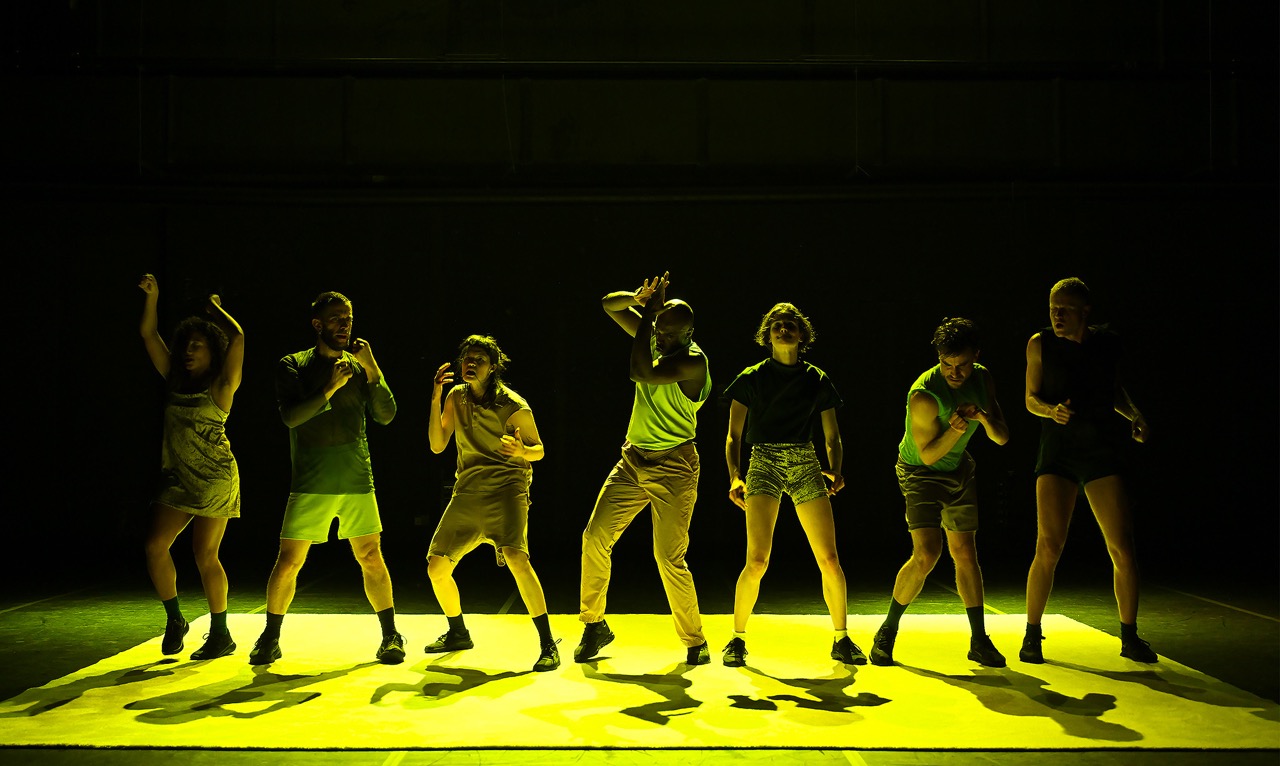
The performance is divided into two parts. There’s what I’d like to call the old world and a new world. I specifically say a new world because it’s not a prediction or a wish. We try to juxtapose two opposite worlds.
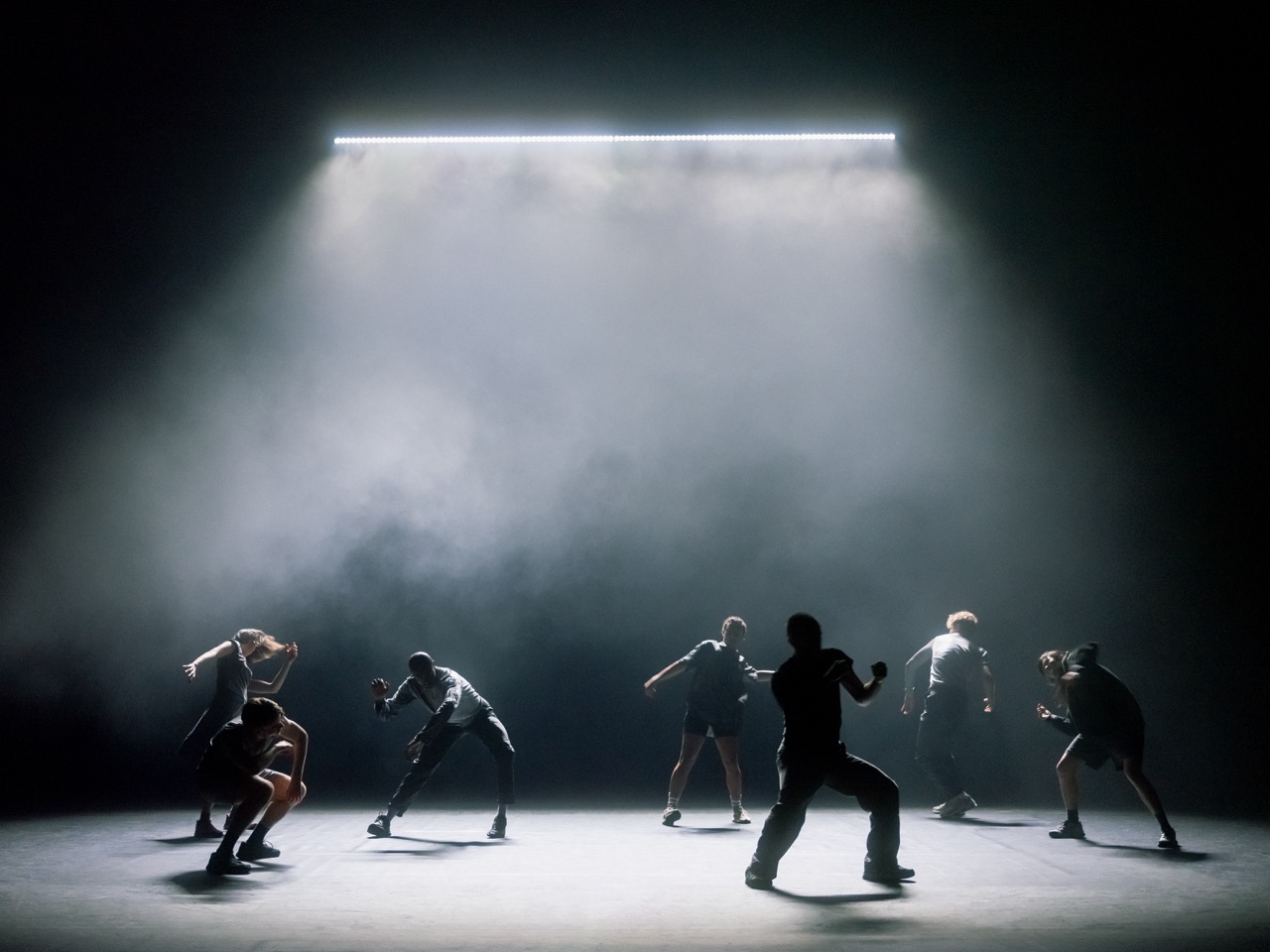
In the first, the lighting is crucial. There’s a strip of light that symbolises the last horizon of that old world. Then, in the second part, there’s a white piece of carpet, which we consider to be a white canvas, a blank page on which we can imagine something else.
Those two elements symbolise two opposing worlds.
Can you talk to us about the music and sound in the show?
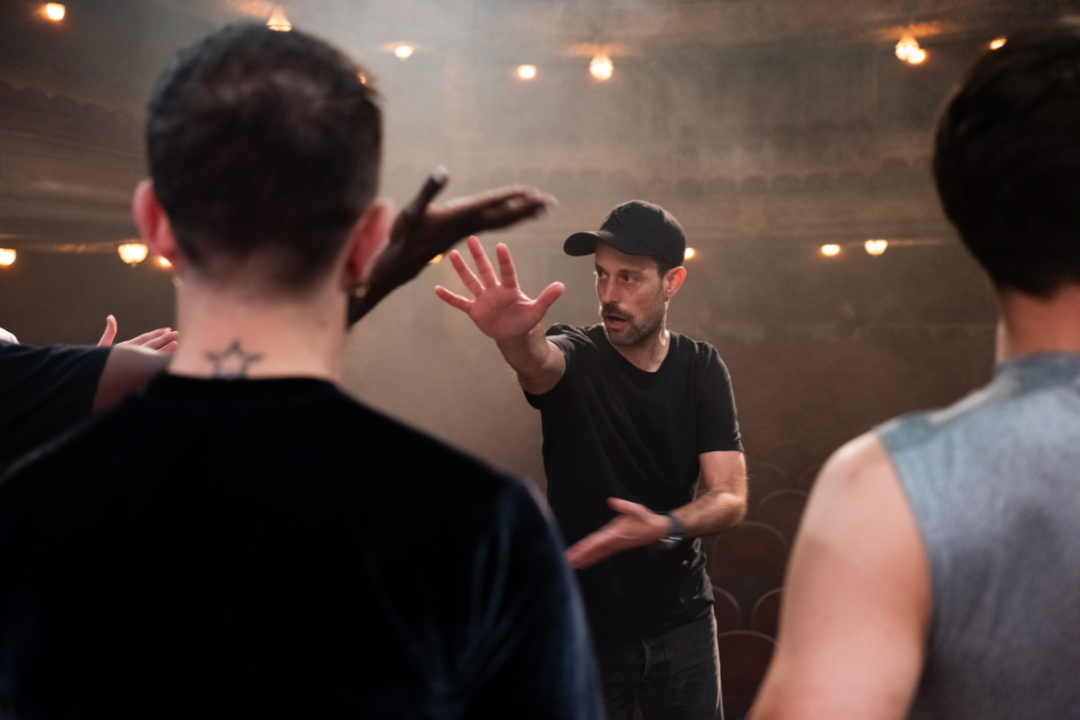
I very much enjoy collaborating with my team on the actual performance. I prefer not to ask a composer to make music for me and then say, “I love this music”, and create a choreography on that. For me, it’s really about shaping the performance collaboratively, almost simultaneously.
Aart Strootman, who is a Dutch composer, and I work together from the beginning. He’s with us in the studio quite a few times during the creation periods, although of course he also needs to be in his own studio.
What I love in Aart’s work is how he’s able to make fascinating music through layering different types of rhythms and instruments, but also how he translates the theme or inspiration for the performance into his music.
For example, towards the end of the first part, you can hear the squeak of a minecart in the music. You don’t really recognise it as such, but there’s something about the way he’s able to use things that don’t seem to be instruments – like a minecart – and find a translation of the theme of the performance through music.
The light does the same thing. We have this one strip of light that symbolises the horizon, but we also light the white piece of carpet, the white canvas, in such a way that we’re able to isolate it from the space. It almost becomes like an island, on which the dancers are completely in a world separate from the world that surrounded them at the beginning.
The way we construct that is really about working together. I love this kind of integration: there’s not only dance, but music and light and scenography, and everything is so integrated that it really becomes something you can experience as a unity.
What experience do you want to create for the audience?
There’s always the question: what is it about the performance? Whenever you ask that question, you want to look for answers right away, so there’s something to be understood.
Even though there is a sense of narration – there’s an old world and there’s a new kind of world coming – I prefer that the audience doesn’t think too much during the performance, but much more experiences the entire performance.
I feel that through our bodies, we’re able to feel much more than we’re able to understand in the moment. Those kinds of experiences really bring us somewhere else, and not into the frame of mind that we already come into the theatre with.
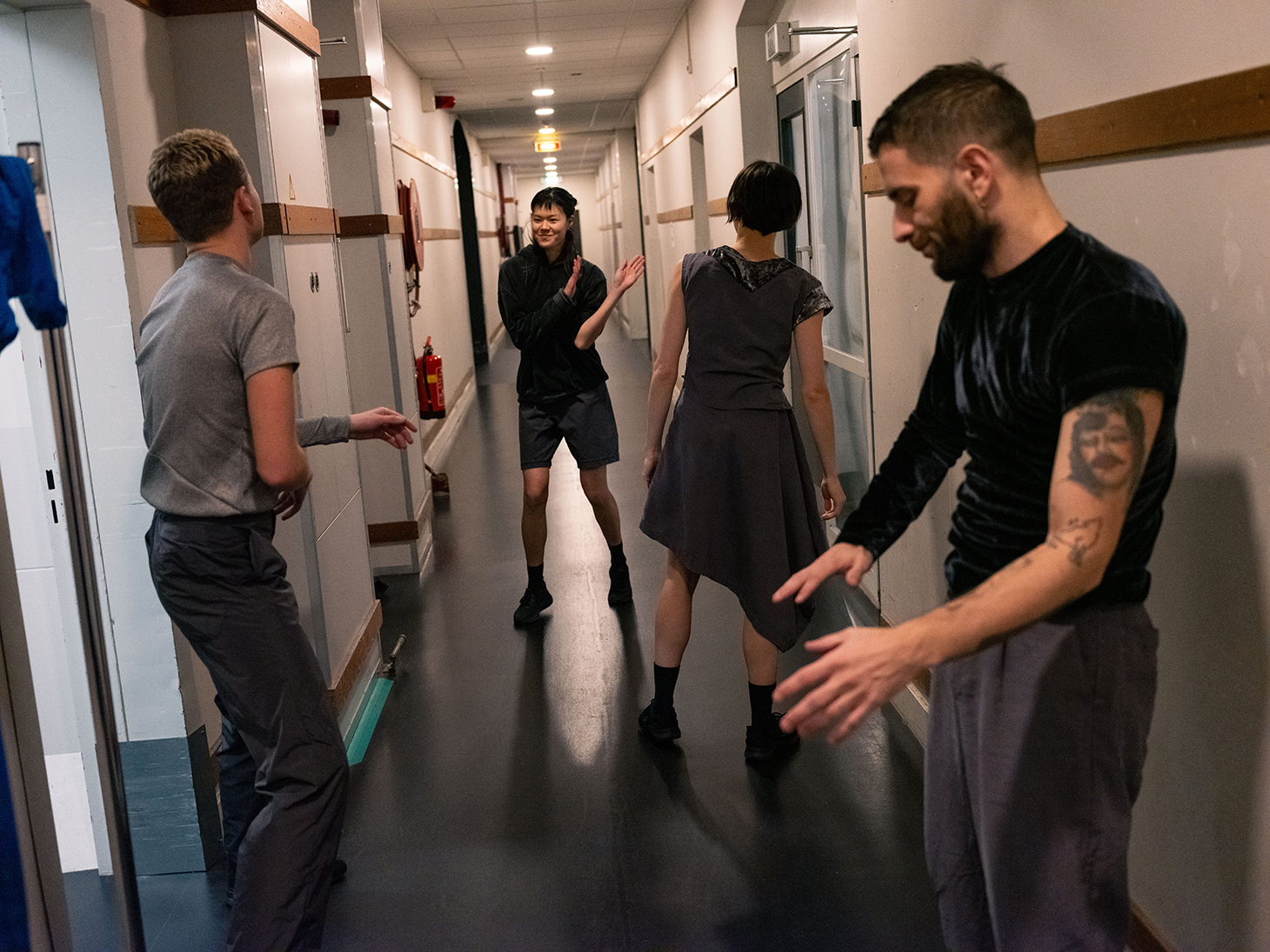
That’s also what I like to work on with the dancers as much as possible. They’re not executing movements in the best way they possibly can, but they move in such a way that you can actually feel their bodies and almost identify with them from a bodily perspective.
Credit Nina Durdević
Can you tell us about your artistic practice and choreographic language?
I think it’s already in the previous answers a little bit, but what I like to work on through this integration of dance, music, light, scenography and also the voices of the dancers in this particular work is to create an experience that is physical and sensorial, and therefore communicates in a very specific way.
In order to achieve that – in order to achieve the dancers moving in a certain way that allows you to feel almost what they’re feeling – I’ve found that the way they ground themselves and their relationship to the floor is crucial.
Almost the entire practice is based on the way they use the floor to move their bodies.
Within dance, there’s a strong style of what they call floor work. I call my approach to physicality “floor work 2.0”, because you never really go to the floor itself. You just use the floor in such a way that you take the energy from it.
If you do that in the way that I’ve developed it, it allows the body to be much more open. So you’re not sending the movements to the audience, but you allow the audience to come to you.
Credit Peteris Viksna
What inspires you to keep making dance, and what's feeding your practice right now?
It all started with the very first experience of dance that I had myself. By now it’s a long time ago, but I didn’t get interested in dance by dancing myself. I got interested in dance by watching a dance performance.
It was out of pure coincidence. I went with a group of colleagues to a show, and it happened to be a dance performance. I got so overwhelmed by that performance that everything seemed to fall into the right place, and I felt completely inside my own body.
I think that first experience is still guiding my current practice and my interest in making dance.
The first years were about discovering that I was doing that. After that, it was about finding a way that I could create that type of experience for an audience as well, and understanding the importance not only of the physical language of the dancers, but also of the music, the light, the scenography and the space.
Bit by bit, I started to accumulate more elements into that, and from there my interest became stronger and stronger in thinking: what can I say with this? Can I say something about the way I see the world, and perhaps not only me, but maybe there’s something for us to reflect on through this experiential type of work?
This has been guiding my practice for the last years, and I keep on discovering new things to talk about. There’s still something to be said.